
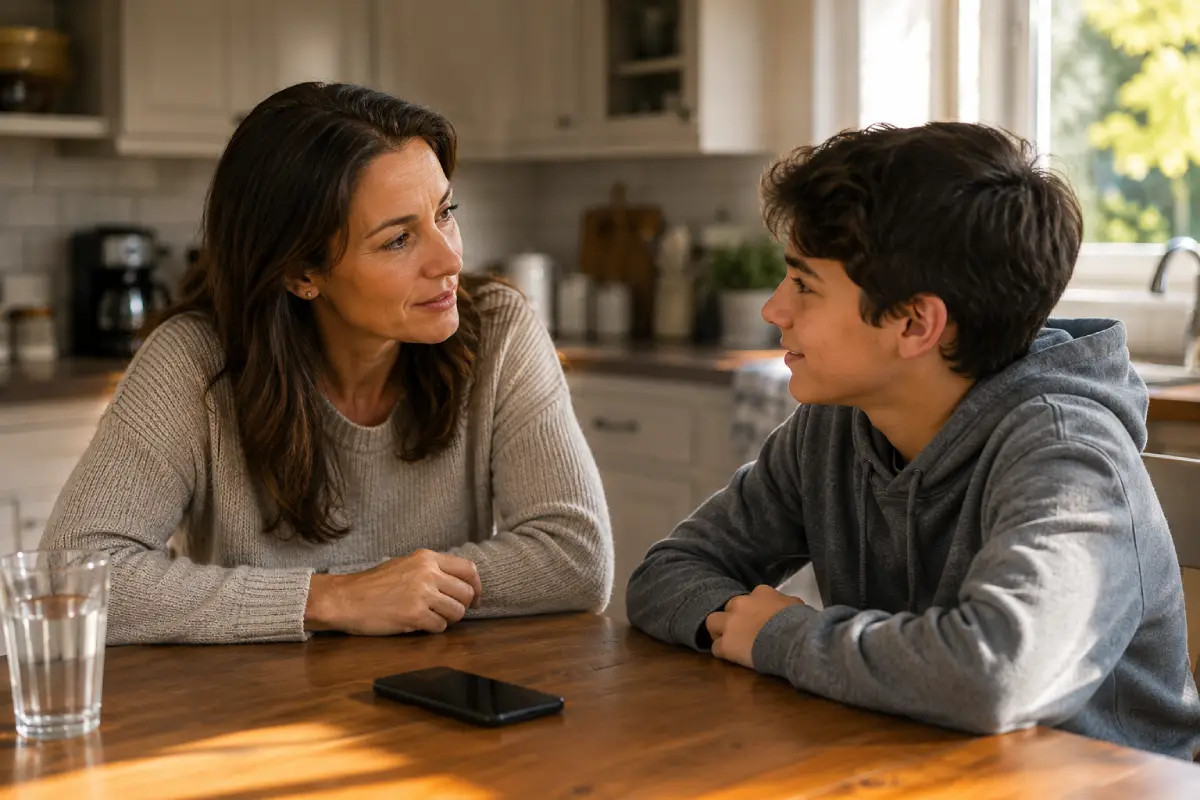

Protect children from online predators effectively in 2026 requires understanding a shift that outpaced most household safety frameworks: gaming platforms now account for 41% of documented grooming incidents, up from roughly 5% in 2019 (Internet Watch Foundation, 2025). Social media remains a risk environment, but it is no longer the primary one. The families most exposed are those who configured their protection layer around Instagram and TikTok before 2023 and haven’t revisited the setup since.
The platforms where the risk is currently concentrated — Roblox chat, Discord server messaging, Fortnite voice channels — fall outside the monitoring coverage of most parental controls configurations built before 2024. Most children using these platforms use them daily. Most parents have reviewed their child’s social media settings and haven’t opened a single privacy panel in a gaming application.
This guide covers the current platform-specific risk landscape, the grooming pattern that operates consistently across every environment, the behavioral warning signs that indicate a child may be targeted, and the monitoring tools and direct conversations that build effective protection. It ends with specific actions a parent can take today regardless of which platforms their child uses.
Why gaming platforms became the primary grooming environment
The single most important shift in how families approach efforts to protect children from online predators happened when gaming added persistent social features at scale. Between 2018 and 2023, Roblox grew its monthly active user base from 78 million to over 200 million, with the majority of users under 16. Over the same period, the platform added in-game chat, friend request systems, and direct messaging infrastructure that operates with minimal age verification and no content moderation comparable to what Instagram or TikTok apply to user-to-user messaging.
Gaming platform child safety received significantly less regulatory and public attention than social media safety during this period. Meta and TikTok invested in minor protection features under sustained FTC pressure. Gaming platforms operated with lighter oversight and slower policy development. The IWF’s 2025 annual report documents the result: gaming environments now generate 41% of grooming incidents, with Roblox, Fortnite, and Minecraft each contributing documented volumes. Discord, technically a messaging application rather than a gaming platform, functions as a gaming-adjacent space — its servers are organized primarily around games and gaming communities and account for a substantial portion of the chat-based grooming incidents in the IWF’s gaming category.
The risk mechanism specific to gaming culture is what makes detection harder for both parents and children. Gaming normalizes gift exchange: in-game currency, rare items, and assistance completing difficult levels are common transactions between players who have never met. A groomer who begins by offering gifts inside Roblox or Fortnite operates within a behavior the child recognizes as normal gaming generosity, not as the opening stage of a predatory approach. The trust-building layer looks indistinguishable from authentic online friendship.
The tools designed to protect children from online predators in the current environment need to reach game chat and gaming-adjacent messaging platforms, not just social media accounts. Bark expanded its gaming platform monitoring in 2025. Qustodio and Net Nanny cover web filtering and screen time but don’t read Roblox chat or Discord message content. The monitoring gap in most households aligns precisely with where the risk is now concentrated.
For the complete layered protection approach — covering router controls, device-level tools, and platform-specific settings alongside online predator awareness — our complete family internet protection guide covers each layer in sequence.
How online grooming works: the five-stage pattern every parent should recognize
Understanding the grooming sequence is foundational to any effort to protect children from online predators because the pattern is highly consistent across all platforms regardless of their interface mechanics. Recognizing the stages in a child’s behavior or communications is the primary early detection system, and it functions even when monitoring software has limited platform coverage.
Stage one: target selection. Groomers identify children who are vulnerable to sustained attention-based manipulation — those experiencing social isolation, family conflict, academic pressure, or low self-esteem who actively seek positive engagement and validation in online spaces. Online grooming prevention begins by understanding that groomers are deliberate in this selection process, not random. Children who describe themselves as feeling misunderstood at home or school are statistically more likely to appear in grooming incident reports.
Stage two: trust and affection building. This is where gaming culture creates the most significant risk difference from social media. The groomer offers in-game gifts alongside consistent attention, compliments, and “special friend” framing. Because gift exchange is normal in gaming communities, this stage proceeds for weeks or months without triggering a child’s awareness. Warning signals at this stage: a child receiving unexplained in-game items or currency from a relatively new contact, or describing an online friendship with an emotional intensity disproportionate to how long they’ve known the person.
Stage three: boundary testing. The groomer introduces topics or requests that fall outside normal online gaming friendship: questions about the child’s appearance, their home location, whether their parents monitor their devices, or their relationship status. These questions are embedded in otherwise normal conversation. This stage frequently includes a request to move contact to a more private platform — from Roblox chat to Discord, from Discord to WhatsApp or Telegram — where the parent has less visibility.
Stage four: isolation from trusted adults. This stage is the clearest behavioral warning sign observable by parents. Phrases that appear in monitored communications or that children may report: “your parents don’t understand you,” “they would just take your phone if they knew we talked,” or “this is between us.” Any consistent effort by an online contact to create secrecy from the child’s parents is a direct indicator that the relationship has moved from normal online contact into predatory grooming.
Stage five: exploitation. The groomer makes explicit requests for photographs, personal information, or real-world contact. Online grooming prevention at every earlier stage is designed to prevent reaching this point — and the research consistently shows that strong parent-child communication and consistent monitoring significantly reduces the probability of reaching it.
Platform-specific risks and the safety settings that reduce them
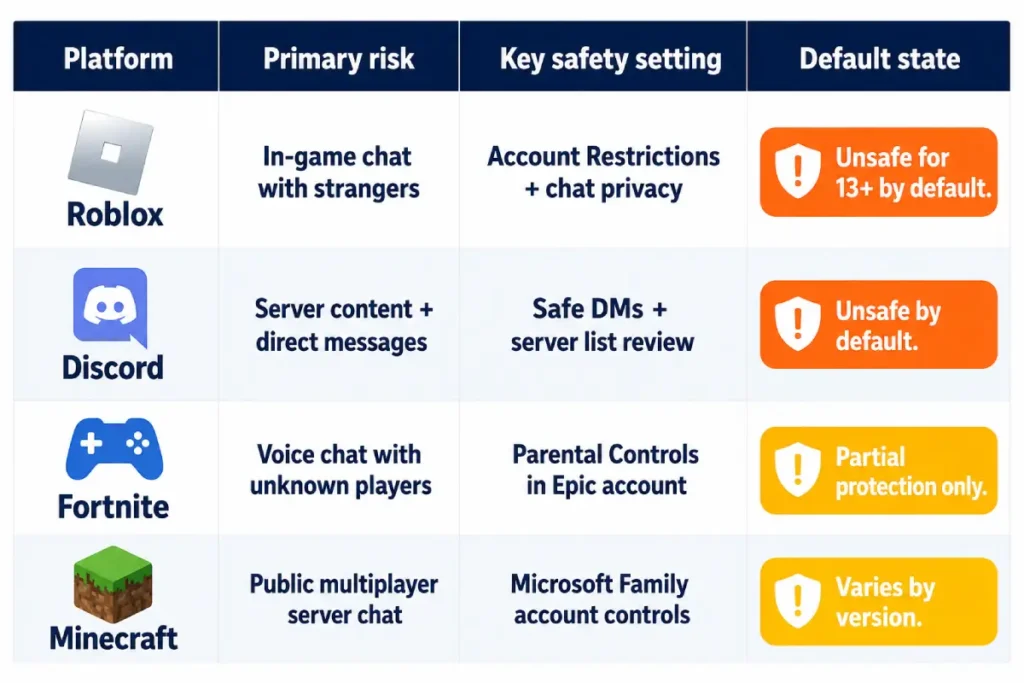
The three platforms where groomers most consistently target children in 2026 reveal how difficult it is to protect children from online predators using only network-level filtering. Roblox.com passes any standard DNS filter. Discord passes any standard DNS filter. Fortnite’s servers are fully accessible on any unfiltered network. The protection layer that actually reduces exposure on these platforms is account-level configuration, not network blocking.
Roblox’s default chat setting for accounts registered as over 13 allows unrestricted in-app messaging with any other user on the platform. The listed account age has no bearing on who can initiate contact — an adult account can message a child’s account unless the child’s settings explicitly prevent it. To configure: open account settings at roblox.com and navigate to Privacy. Set “Who can chat with me in app?” to “Friends.” Set “Who can send me messages?” to “Friends.” Set “Who can trade with me?” to “No one” unless the child actively trades. For children under 10, enable Account Restrictions mode under Parental Controls — this limits play to Roblox-approved experiences and disables all chat simultaneously. Secure the parent PIN to prevent the child from reversing these settings independently.
Discord operates with no native parental controls panel and no functioning age verification. Its stated minimum age is 13. The highest-risk element on Discord isn’t the app’s global settings — it’s the server list. Many servers that host adult content apply a simple age gate that any user can bypass by clicking “I am over 18” with no verification required. For any child under 13, the correct configuration is no Discord account. For teenagers 13 and older, review the full server list monthly. In Privacy & Safety settings, enable Safe Direct Messaging to filter incoming direct messages for explicit content. Set friend requests to “Friends of Friends.” Discuss with the child which servers they’ve joined and establish a household rule that new server joins require a brief parent review.
Fortnite’s primary risk is voice chat, which enables real-time, unmonitored audio contact between players in a match without leaving any written record that monitoring software can scan. Epic Games account parental controls are accessible at epicgames.com/account under the Parental Controls section. A parent PIN protects these settings. Disable or restrict voice chat under Communication Preferences. In regions that support it, Cabined Account mode applies additional social feature restrictions to accounts where the registered age is under 13 — verify the child’s account status in the Epic dashboard.
Minecraft presents two distinct risk profiles depending on the version. Minecraft Java Edition, played primarily on PC, allows players to join any public multiplayer server without age restriction or content filtering — some community servers have minimal moderation. Minecraft Bedrock Edition, used on consoles and mobile, links to a Microsoft account. Parental controls for Bedrock are accessible at account.microsoft.com/family and include options to restrict multiplayer to friends only and disable cross-platform communication entirely.
These platform-level configurations form the most immediately actionable layer for parents who want to protect children from online predators through gaming environments. Gaming platform child safety setup across all four platforms takes approximately 45 minutes for a first-time configuration and should be reviewed every six months as platform interfaces and default settings evolve.
Online predator warning signs in a child’s behavior and device use
Several behavioral patterns warrant immediate attention in any effort to protect children from online predators regardless of which platform they use. These signals rarely appear in isolation — most documented cases involve a cluster of changes that develop gradually over two to six weeks, making the pattern more recognizable in retrospect than it seems at any single point.
Behavioral patterns that warrant attention include a sudden increase in online activity outside the child’s established schedule, particularly during late-night hours. Secretiveness about device use — turning the screen away when a parent approaches, closing apps immediately when someone enters the room, or taking messages and calls in private spaces the child didn’t previously use — is a consistent early indicator. Emotional withdrawal or mood changes clustering around or after device use, distinct from the child’s general emotional baseline, appear in the majority of documented grooming cases.
The intensity with which a child describes a specific online contact matters as much as the frequency of communication. When a child refers to an online-only relationship using phrases like “the only person who really understands me,” describes an older player as being unusually generous or attentive, or becomes defensive when the contact is questioned, these descriptions reflect Stage 2 and Stage 3 of the grooming pattern outlined in the previous section.
Receiving unexplained in-game items, currency, or physical gifts is one of the most specific online predator warning signs in the gaming context. A child who suddenly has rare items or large amounts of in-game currency with no explanation of where they came from has received a grooming gift. The same applies to unexpected gift cards sent to an email address or phone number the child hasn’t disclosed to the parent.
Device use patterns that indicate concealment include applications on the device the parent doesn’t recognize — particularly anonymous social or meeting applications — multiple accounts on the same platform, browsing history that is consistently cleared before the device is shared or returned, and contact names saved as numbers or usernames with no identifiable last name. A second account on the same platform is specifically significant: it indicates the child is maintaining a version of their digital life the parent can see alongside one they can’t.
The gaming-specific pattern most consistently documented in online safety research: a child who has developed an unexplained emotional dependency on an older gaming contact, who may describe being “taken care of” or “protected” by that person in the game, or who resists parental requests to limit contact with a specific player in a way that seems disproportionate to the length of the relationship.
When a warning sign appears, the most counterproductive immediate response is a confrontational one — confiscating the device without explanation or demanding to see communications before establishing any conversational safety. This approach closes the communication channel and significantly reduces the probability that the child will come forward in future situations involving online distress. The more effective response is a calm, non-judgmental opening that focuses on the child’s experience rather than the suspected behavior: “I’ve noticed you seem stressed after being online recently — can you tell me what’s going on?” The objective is connection and information, not immediate restriction.
For the conversation frameworks and specific language that build this kind of communication before a warning sign appears, see our guide to safe internet habits for kids.
Monitoring tools that protect children from online predators in gaming environments
Monitoring tools fill the coverage gap that platform safety settings can’t close in any complete effort to protect children from online predators. Platform settings reduce the probability of initial contact. Monitoring tools detect when contact has occurred despite those settings and alert parents before the relationship progresses through the grooming stages.
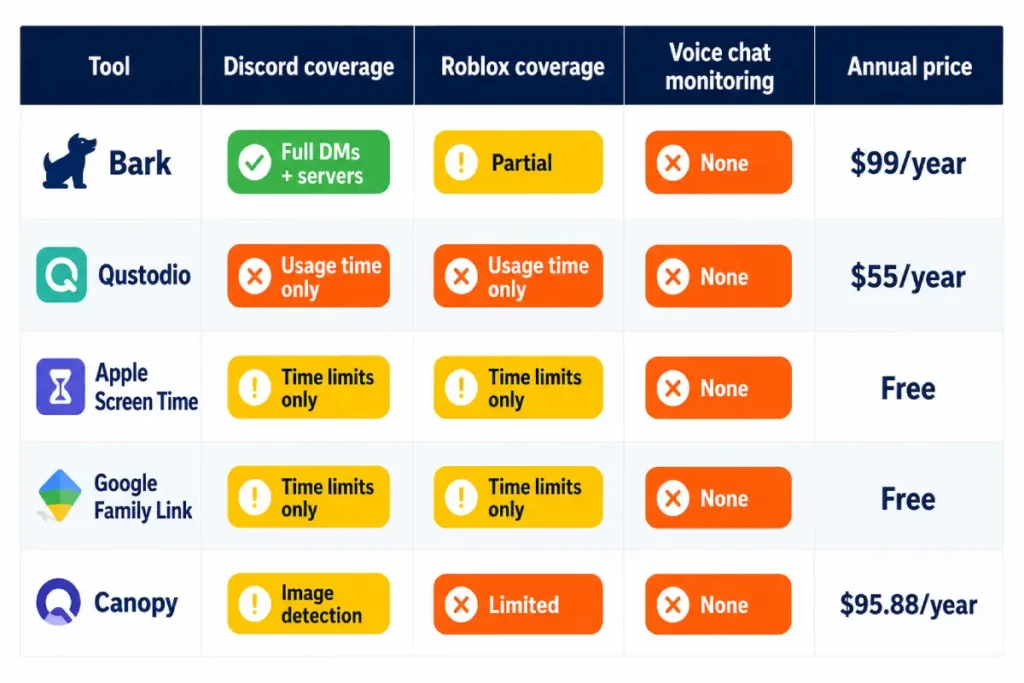
Bark is the monitoring tool with the most relevant gaming platform coverage in 2026. It monitors Discord fully — both direct messages and server channel messages — alongside Reddit gaming communities, Instagram gaming content, TikTok, Snapchat, and most other platforms where gaming communities migrate for communication outside the game itself. Bark’s Roblox integration, added through the platform’s parent account API, covers certain message types but not every in-game communication channel. The consistent limitation across all monitoring software: voice chat. No currently available parental controls application can scan real-time audio communication inside any gaming platform, which means Discord voice channels and Fortnite in-game audio remain unmonitored regardless of the tool in place.
Apple Screen Time and Google Family Link don’t read message content on any platform, but they do allow parents to restrict which apps can be opened, set daily limits on gaming applications, and require approval before the child downloads new communication apps. These controls don’t detect predatory contact, but they do restrict the hours during which contact can occur and block the installation of anonymous messaging applications that groomers use to move communication off platforms where monitoring exists.
The combination that provides the most complete available coverage to protect children from online predators through monitoring: Bark on the child’s primary devices alongside the platform-level privacy configurations from the previous section. Bark catches concerning patterns in text-based messaging. Platform settings reduce the probability that a groomer can initiate contact at all. Neither layer covers gaming voice chat — this gap is closed by disabling voice chat on gaming platforms for children under 13, and by maintaining the open parent-child communication channel for older teenagers to report uncomfortable in-game interactions.
Monitoring software’s role in gaming platform child safety is secondary to the conversation layer in any online grooming prevention strategy. The alert system functions only if the child understands it as a safety resource rather than a surveillance mechanism.
The conversations that help protect children from online predators before an incident occurs
Building these conversations into the household’s approach to protect children from online predators makes every monitoring tool and every platform setting more effective. The evidence across online safety research is consistent: children who have had specific, concrete conversations about online contact are significantly more likely to report concerning situations early — before the grooming relationship reaches a critical stage.
Three conversations form the core preventive framework.
The first is the trusted adult conversation, appropriate from age 6 and revisited at each new platform introduction. A safe relationship online — with a teacher, a known family friend, or a gaming peer the family has met in person — doesn’t require secrecy, doesn’t involve gifts in exchange for special attention, and doesn’t ask the child to move communication to a different app. Any online contact who does these things is not a safe person, regardless of how long the child has known them or how well the contact claims to understand them.
The second is the surprises versus secrets distinction for children aged 6 to 10: surprises are temporary and eventually shared with trusted adults; secrets that must be kept from parents permanently are a signal that something is wrong. This framing gives younger children a concrete test they can apply without requiring them to understand grooming as a concept.
The third — and the single most functionally important element of online grooming prevention across all age groups — is the no-punishment-for-telling commitment. A 2025 Common Sense Media survey found that 67% of children aged 10 to 15 who experienced concerning online contact didn’t tell a parent because they expected device removal as a consequence. The explicit, repeated commitment that coming to a parent about an online problem will never result in losing device access is what creates the reporting channel that monitoring software depends on. Without it, children manage online threats privately.
These conversations are most effective when held proactively, before a specific concern exists. Brief revisitation every three to four months — or at each new platform introduction — sustains the family internet protection layer that monitoring software can’t substitute for.
How to protect children from online predators when an incident has already occurred
When concerning contact is discovered — through a monitoring alert, the child’s own disclosure, or a parent’s direct review of a device — the sequence of steps in the first hour matters to both the legal outcome and the child’s emotional recovery.
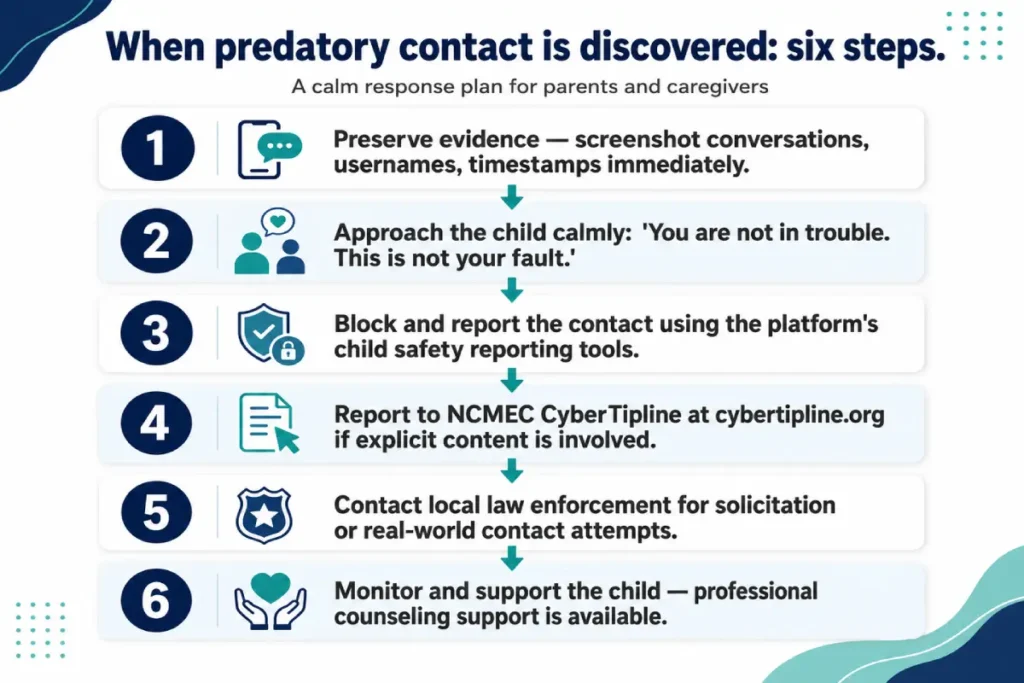
Preserve the evidence before anything else. Screenshot the full conversation: the messages, the platform username of the contact, the date and time stamps, and the child’s profile. Do not delete any communication. Evidence removed before documentation is unrecoverable and may prevent any law enforcement action. If the contact account disappears after the discovery, the screenshots are what remain.
Approach the child without blame before contacting any authority. Children in this situation frequently experience shame, guilt, or fear of having done something wrong. Beginning with “you are not in trouble and this is not your fault” before asking any question determines whether the conversation produces information or shuts down entirely.
Remove the contact immediately: block the account on the platform, then report it to the platform’s child safety reporting team. Roblox, Discord, Epic Games, and Mojang each have specific child safety reporting pathways — use them. Platform reports initiate internal investigations that can identify patterns across multiple affected accounts.
Report to the National Center for Missing and Exploited Children CyberTipline at cybertipline.org for any contact involving solicitation for images, sexual conversation, or explicit material. The CyberTipline routes reports to law enforcement agencies with jurisdiction. For contacts involving explicit solicitation or real-world meeting attempts, contact local law enforcement directly in addition to the NCMEC report and bring the documented screenshots.
Each step in this protocol matters to the overall effort to protect children from online predators and to the recovery of the specific child involved. Reporting also matters beyond the immediate household: the same individual frequently targets multiple children across the same platform.
Frequently asked questions
At what age should parents begin talking about online safety and grooming?
The first foundational online safety conversation — covering what a trustworthy adult relationship looks like and what to do when an online contact makes a child uncomfortable — is appropriate from age 6, coinciding with when most children begin independent device use. More specific conversations about grooming patterns, gift-based trust building, and what predatory gaming platform child safety awareness looks like in practice are appropriate from age 9 to 10. Every new platform introduction is a natural occasion to revisit the conversation at whatever level matches the child’s current developmental stage.
What is the single most effective thing a parent can do to reduce grooming risk?
The most consistently supported finding across online safety research: establishing and visibly maintaining the no-punishment-for-telling commitment reduces the probability of a child managing predatory contact privately and without support. This commitment — stated explicitly, repeated every few months, and demonstrated when a child does come forward with a concern — creates the reporting channel that every monitoring tool depends on to produce intervention rather than just detection. Platform settings and monitoring software reduce opportunity. This family internet protection conversation principle is what makes detection translate into actual help.
Can groomers be other teenagers rather than adults?
Yes. A significant portion of documented online grooming incidents involve offenders under 18, including teenagers who may themselves have been victimized previously. The behavioral pattern — trust building, gifts, boundary testing, secrecy requests — is identical regardless of the offender’s age. For children under 13, the appropriate message is that any online contact who requests secrecy from parents presents the same online predator warning signs as an adult contact: the age of the contact doesn’t change what the behavior means.
How do I report predatory contact on a specific gaming platform?
Each major platform has a direct child safety reporting pathway. On Roblox: Account Settings > Privacy > Report Abuse, or the in-game Report button on the contact’s profile. On Discord: right-click the user’s profile, select Report User, and choose the child safety category. For Epic Games accounts including Fortnite: use the in-game report feature or visit epicgames.com/help. Minecraft Bedrock Edition reports go through the Microsoft Report a Concern tool. Submit a parallel report to the NCMEC CyberTipline at cybertipline.org for any contact involving explicit content or direct solicitation.
My child describes an online contact who “really understands them.” Should I be concerned?
The phrase itself isn’t an immediate alarm — genuine online friendships develop regularly. The combination that warrants a direct but calm conversation: the contact is an adult or significantly older, the relationship developed quickly and with unusual emotional intensity, the contact has provided in-game gifts or currency, and the child has become reluctant to discuss the relationship or has mentioned any element of secrecy. Maintaining this kind of open dialogue is the central family internet protection principle that all technical tools support. Any one of these factors justifies a question. The full combination is a consistent pattern from documented grooming incident reports.