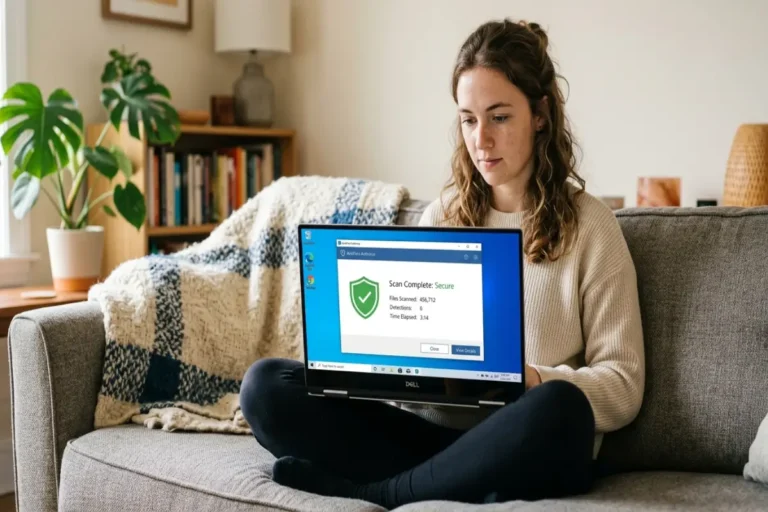
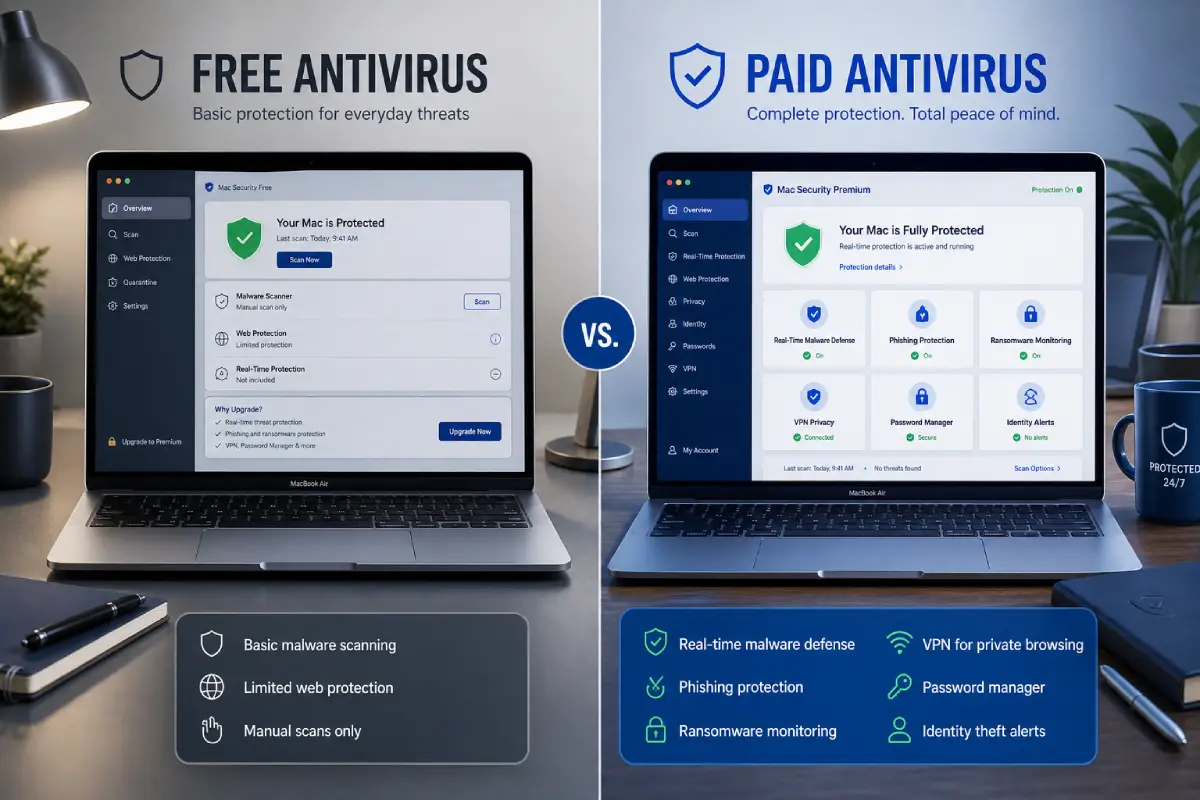

Free vs paid antivirus for Mac is one of the most common questions for Mac users who want better security but do not want to waste money. Some users believe free antivirus is enough because macOS already includes strong built-in security. Others prefer paid antivirus because they want real-time protection, phishing defense, VPN privacy, ransomware monitoring, password protection, and identity alerts.
The truth is that both options can make sense. The best choice depends on how you use your Mac, what you need to protect, and how much risk you are comfortable with.
A free antivirus can be useful for simple scanning and basic malware detection. It may help users check whether their Mac has unwanted apps, adware, or known malware. For casual users who only browse trusted websites, stream videos, write documents, and download apps from official sources, a free tool may be enough as an extra safety layer.
Paid antivirus usually goes further. It often includes real-time protection, anti-phishing tools, ransomware behavior monitoring, privacy features, VPN access, password managers, breach alerts, and multi-device coverage. These features matter more if you work online, use public Wi-Fi, shop online, manage business accounts, download files often, or store valuable documents.
Apple already provides important built-in macOS protections, including Gatekeeper, notarization, XProtect, app permissions, and FileVault. These features make Mac security stronger from the start. But built-in protection does not stop every online risk. A fake login page can steal your password. A suspicious browser extension can affect privacy. A fake update can trick you into installing unsafe software. Public Wi-Fi can create privacy concerns. This is where third-party antivirus software can add value.
The goal is not to say that every Mac user must pay for antivirus. The goal is to understand the difference between free and paid protection so you can choose the right level of security.
What free antivirus for Mac usually includes
Free antivirus software is usually designed to give users basic protection. It can help with simple malware detection, manual scanning, and sometimes limited web protection.
Basic malware scanning
Most free Mac antivirus tools include some type of malware scanner. This scanner checks files, apps, and system areas for known threats. It may detect malware, adware, spyware-like behavior, or potentially unwanted applications.
This is useful if your Mac is acting strangely or if you want a second opinion. For example, if your browser keeps redirecting, pop-ups appear often, or unknown apps are installed, a free scan may help identify the problem.
However, free scanning is usually limited compared with paid protection. Some free tools only scan when you manually start them. That means they may not block threats in real time.
Manual scans
A free antivirus may require you to start scans manually. This can be fine for careful users, but it creates a gap. If you forget to scan, suspicious files may stay on the device longer.
Manual scanning is useful, but it is reactive. It checks after something may already be on the Mac. Paid antivirus usually focuses more on prevention.
Limited web protection
Some free antivirus tools include basic web protection, but it may be limited. It may block known dangerous websites or warn about some suspicious pages.
The problem is that phishing and scam websites change quickly. Strong anti-phishing protection usually requires more advanced browser protection and frequent updates.
Basic adware detection
Free antivirus tools often detect adware and unwanted apps. This is valuable because adware is one of the more common Mac problems. It can change browser settings, show pop-ups, redirect searches, and create a messy browsing experience.
For many casual users, adware cleanup is one of the biggest benefits of free antivirus.
Limited support
Free antivirus usually comes with limited customer support. You may need to rely on help articles, community forums, or basic support pages.
This may be fine for simple users, but it can be frustrating if you are dealing with a serious issue or need quick help.
What paid antivirus for Mac usually includes
Paid antivirus normally includes broader protection. It is designed for users who want active security, privacy features, and easier protection across daily online activity.
Real-time malware protection
Real-time protection is one of the biggest differences between free and paid antivirus. Instead of waiting for you to start a scan, real-time protection checks files, downloads, apps, and suspicious activity as they happen.
This is useful because many threats need to be blocked before they run. If you download a suspicious file, open an unsafe attachment, or install a questionable app, real-time protection can warn you quickly.
For Mac users who download files often, real-time protection is one of the strongest reasons to choose a paid plan.
Advanced anti-phishing protection
Phishing protection is extremely important for Mac users. Many security problems today happen through fake websites, not traditional viruses.
A phishing page can copy the design of Apple, Google, Microsoft, PayPal, banks, cloud storage services, social media platforms, or delivery companies. If you enter your login details, attackers can access the account even if your Mac is clean.
Paid antivirus often includes stronger anti-phishing tools that warn you before you enter sensitive information on suspicious websites. This is valuable for anyone who shops online, manages email, uses cloud storage, or handles work accounts.
Ransomware monitoring
Paid antivirus may include ransomware monitoring. This feature watches for suspicious file behavior, such as attempts to encrypt, lock, rename, or rapidly modify many files.
For Mac users who store important documents, creative projects, photos, business files, school work, or client data, ransomware protection can be valuable. Even if ransomware is not the most common Mac threat, the damage can be serious.
VPN privacy
Many paid antivirus suites include a VPN. A VPN helps protect your internet traffic on networks you do not fully trust, such as public Wi-Fi in cafés, airports, hotels, schools, and coworking spaces.
A VPN is not the same as antivirus. Antivirus helps with malware, phishing, and suspicious behavior. VPN helps with connection privacy. Together, they can provide stronger online protection.
However, not every antivirus VPN is equal. Some plans include unlimited VPN, while others limit data or require a higher-tier subscription.
Password manager
Some paid antivirus plans include a password manager. This helps users create and store strong unique passwords.
Password reuse is risky. If one website is breached and you use the same password on other accounts, attackers may try that password elsewhere. A password manager makes it easier to avoid this problem.
Identity and breach alerts
Paid antivirus may include identity monitoring or breach alerts. These features can notify you if your email address or personal information appears in known data breaches.
This is useful for people who manage important accounts, online businesses, banking, cloud storage, or client work.
Multi-device protection
Paid antivirus often covers multiple devices. This can include Mac, Windows, iPhone, Android, and tablets.
For families or users with several devices, paid antivirus can be better value than installing separate free tools everywhere.
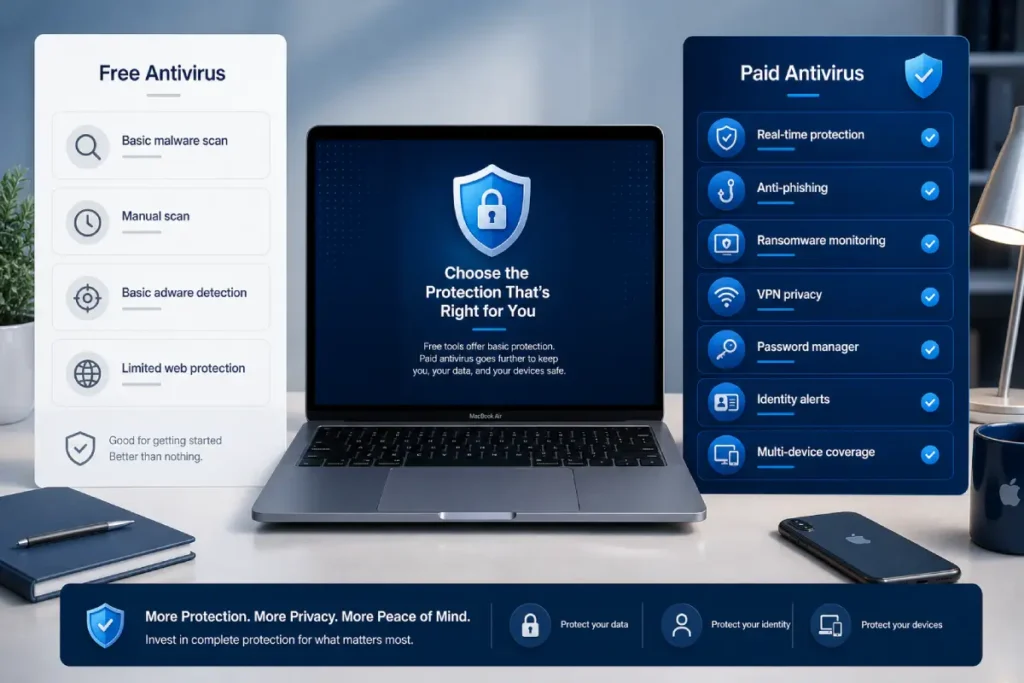
Free antivirus for Mac: pros and cons
Free antivirus can be useful, especially for users who need basic protection without paying. But it is important to understand the limits.
Pros of free antivirus
The biggest advantage is cost. Free antivirus gives you some protection without a subscription. This is useful for students, casual users, or people who are not ready to pay for security software.
Free antivirus can also help detect adware and unwanted apps. If your browser is behaving strangely, a free scan may help clean up basic issues.
Another benefit is testing. You can use a free version to see if you like the interface, scan speed, and alerts before upgrading to a paid plan.
Cons of free antivirus
The biggest weakness is limited protection. Many free tools do not include full real-time protection, advanced anti-phishing, ransomware monitoring, VPN, password manager, or identity alerts.
Free antivirus may also include upgrade prompts. Some free tools constantly remind users to buy the paid version. This can become annoying.
Another limitation is support. If something goes wrong, free users may not receive fast help.
Free antivirus is also less ideal for users who work online, use public Wi-Fi, download files often, or manage important accounts. In those cases, the missing features may matter.
Paid antivirus for Mac: pros and cons
Paid antivirus is usually stronger, but that does not mean every paid plan is worth buying. You still need to compare features, performance, and pricing.
Pros of paid antivirus
The main advantage is broader protection. Paid antivirus usually includes real-time malware defense, phishing protection, ransomware monitoring, privacy features, and safer browsing tools.
Paid plans are also better for convenience. Instead of managing different tools separately, you may get antivirus, VPN, password manager, and identity alerts in one suite.
Multi-device coverage is another advantage. One subscription may protect your MacBook, phone, tablet, and family devices.
Paid antivirus also usually includes better customer support. This matters if you rely on your Mac for work or business.
Cons of paid antivirus
The main disadvantage is cost. Antivirus subscriptions can become expensive, especially after the first-year discount ends.
Some paid plans also include features you may not need. For example, a casual user may not need advanced identity monitoring or unlimited VPN.
Another issue is performance. Most good antivirus tools are optimized, but some security suites can feel heavier than others. Mac users should choose software known for low system impact.
Finally, paid antivirus does not replace smart habits. You still need to keep macOS updated, avoid suspicious downloads, use strong passwords, and be careful with links.
Which Mac users can use free antivirus?
Free antivirus can be enough for some users. The key is to match the tool to your risk level.
Casual users
If you mainly use your Mac for browsing, streaming, documents, and trusted apps, free antivirus may be enough as a basic extra layer.
You should still keep macOS updated, use strong passwords, and avoid suspicious websites.
Students with basic needs
Students with simple browsing and document work may use free antivirus if they do not download risky files or manage sensitive accounts.
However, students who use campus Wi-Fi often may benefit from VPN protection, which is usually paid.
Users who only want occasional scans
Some Mac users only want to scan the device once in a while. A free antivirus can work for this purpose.
This is useful if you mostly trust your browsing habits but want a backup check.
Users testing a brand
Free antivirus can be a good way to test a product. If the app is clean, fast, and easy to use, you may decide to upgrade later.
Which Mac users should choose paid antivirus?
Paid antivirus makes more sense for users with higher risk, more valuable data, or more frequent online activity.
Remote workers
Remote workers often manage business email, cloud documents, client files, video calls, project tools, and payment systems. Paid antivirus with phishing protection, VPN, and ransomware monitoring can be worth it.
Freelancers and creators
Freelancers and creators download many files, work with clients, use cloud platforms, and store creative projects. A paid plan can protect against suspicious downloads, phishing, and file-related threats.
Business owners
Business owners often use Macs to manage websites, online stores, ad accounts, payment processors, banking, customer data, and supplier communication. For this group, stronger protection is smart.
Travelers
Travelers often use public Wi-Fi in airports, hotels, cafés, and coworking spaces. Paid antivirus with VPN can be useful for safer browsing on shared networks.
Families
Families usually need protection across several devices. A paid multi-device plan can be easier to manage than separate free tools.
Users who want simple all-in-one protection
Some people prefer one security suite instead of separate apps for antivirus, VPN, password management, and identity alerts. Paid antivirus can be more convenient.
Security features worth paying for
Not every paid feature is equally important. Some features are worth paying for more than others.
Real-time protection
Real-time protection is one of the most valuable paid features. It helps stop threats before they run.
If you download files often or install apps from outside the App Store, this feature is worth considering.
Anti-phishing protection
Anti-phishing protection may be even more important than traditional malware scanning for many users. Fake websites can steal passwords and payment details without infecting the device.
This feature is especially useful for people who use online banking, cloud storage, business dashboards, ad accounts, or payment platforms.
VPN
VPN is worth paying for if you often use public Wi-Fi or want more privacy on shared networks.
If you only use trusted home Wi-Fi, VPN may be less important.
Ransomware monitoring
Ransomware monitoring is worth paying for if you store important work locally. This includes documents, photos, creative assets, school projects, business files, and client folders.
Password manager
A password manager is worth using, whether it is included in antivirus or purchased separately. Strong unique passwords are essential for account security.
Identity alerts
Identity alerts are useful if you want to know when your email or personal information appears in breach data. This is more valuable for people who manage many accounts.
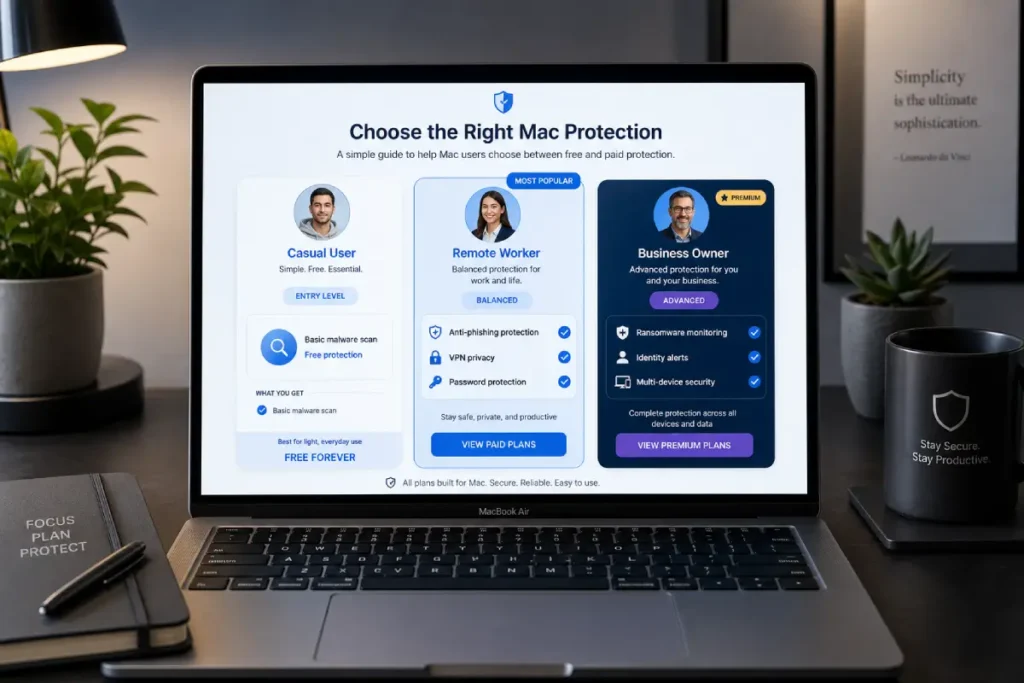
Free vs paid antivirus for MacBook Air
MacBook Air users usually care about speed, battery life, and simplicity. Free antivirus may work for basic users, but paid antivirus can be useful if the device is used for school, travel, work, or public Wi-Fi.
A lightweight paid antivirus with real-time protection and anti-phishing can be a good balance. Avoid heavy security suites that slow down the MacBook Air or drain battery.
If you use your MacBook Air mainly for browsing and documents, free antivirus may be enough. If you work remotely, travel often, or download files regularly, paid protection is usually better.
Free vs paid antivirus for MacBook Pro
MacBook Pro users often have more valuable files and professional workflows. Paid antivirus is usually easier to justify if the device is used for income, client work, development, design, video editing, or business.
The most important features for MacBook Pro users are real-time protection, anti-phishing, ransomware monitoring, secure downloads, and low performance impact.
Free antivirus can help with basic scanning, but paid protection is usually better for professional use.
How to compare antivirus value
Do not compare antivirus plans only by price. Compare value.
Check protection features
Look for real-time malware protection, anti-phishing, ransomware monitoring, and safe browsing. These are core features.
Check performance impact
A good Mac antivirus should not slow your device. Look for independent testing and user reviews focused on Mac performance.
Check VPN limits
If a VPN is included, check whether it is unlimited or limited. Also check whether it is included in the basic plan or only in higher tiers.
Check device count
A plan that covers five or ten devices may be better value than a cheaper plan that covers only one Mac.
Check renewal pricing
Many antivirus brands offer low first-year pricing. Renewal pricing can be higher. Always check long-term cost.
Check support
If your Mac is important for work, customer support matters. Paid plans usually offer better support than free plans.
Common mistakes when choosing free or paid antivirus
Choosing only the cheapest option
The cheapest tool is not always the best. A low price is not valuable if important features are missing.
Paying for features you do not use
The most expensive plan is not always necessary. Choose based on your real needs.
Installing multiple antivirus tools
Do not install several antivirus apps at the same time. They can conflict and slow your Mac.
Ignoring macOS updates
Antivirus does not replace system updates. Keep macOS and browsers updated.
Forgetting safe browsing habits
Even paid antivirus cannot protect against every mistake. Be careful with links, downloads, permissions, and passwords.
Final verdict: free or paid antivirus for Mac?
Free antivirus for Mac can be enough for casual users who want basic scanning and simple extra protection. It is useful for occasional checks, adware detection, and users with low-risk habits.
Paid antivirus is better for users who want real-time protection, anti-phishing defense, ransomware monitoring, VPN privacy, password tools, identity alerts, and multi-device coverage. It is especially useful for remote workers, freelancers, business owners, travelers, families, and users who store important files.
The best choice depends on your risk level. If your Mac is mainly for simple browsing and trusted apps, free antivirus may be enough. If your Mac is connected to your work, money, accounts, travel, or private files, paid antivirus is usually the smarter option.
Best Antivirus for Mac → Best Antivirus for Mac in 2026: Top Picks